Case study · Data & governance · AI/ML
Making sensitive child audio usable, legally and ethically
Turned legal and ethical uncertainty into working processes: a 28-country data-protection handbook, risk assessments, an ethics board, and a licensing approach for releasing a model trained on children's audio.
- My role
- Led data-protection practice and model governance; co-authored a 28-country handbook
- When
- 2021–2024
- Read
- 3 min read
The problem
Our recordings capture young children and their families at home, including bystanders who never signed anything, in many countries. Each country has different rules, and most researchers don't have the legal support to read and interpret local legislation. In addition, using these data for AI modelling raised new questions: could releasing the model leak information about the families, and who should be allowed to use it? Research teams needed practical answers, not obscure legal advice.
Constraints
- GDPR plus national legislation in every country where data was, or could be, collected
- Community data sovereignty: some data came with requirements set by Aboriginal leadership
- Multiple organisations had oversight but not the specific expertise (e.g., European Research Council ethics review, CNRS)
- Safeguards had to protect families without making the data useless for science
My approach
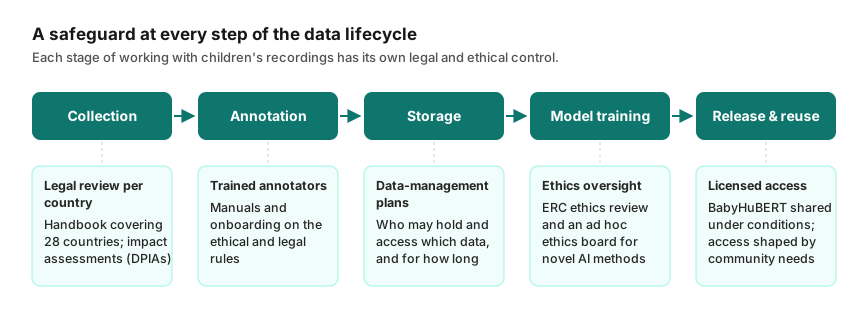
I worked with specialists across law and ethics to design data-management plans and Data Protection Impact Assessments for research with children and caregivers, then turned them into day-to-day workflows across the data lifecycle: collection, annotation, storage, analysis and reuse. To give teams practical answers rather than legal texts, I co-authored a country-by-country handbook of the relevant legislation. During the ERC ethics review, I translated between ethics reviewers and technical staff and set up an ad hoc ethics board. For BabyHuBERT, I designed the governance, including a licensing approach that limits how a model trained on children's audio can be used.
Results
- 28 countries, incl. 6 in continental EuropeLegislation reviewed
- Data from families in 25+ countriesProgramme scope
These were the first such practices for sensitive child-centred audio at CNRS, and the handbook is now public guidance for teams worldwide. I have since advised ethics boards and international scientific archives on responsible reuse of this kind of data.
Trade-offs
Release BabyHuBERT under a licence with conditions, rather than fully open or not at all
Fully open weights would maximise reuse but give no recourse against misuse of a model trained on children's voices. Not releasing it would waste a public investment and slow down the field. A licence keeps the model useful while setting clear limits.
- Fully open release
- Keep the model internal
- Share only through individual collaborations
Write country-by-country practical guidance instead of applying one global policy
Applying the strictest regime everywhere blocks legitimate work, while leaving each team to work it out alone produces inconsistent and risky practice.
- Apply GDPR-level rules everywhere
- Leave compliance to each local team
Let community requirements shape access, not just the law
Legal compliance is the floor. Trust from the communities who share their data is what makes the work possible in the long run.
What I learned
- Governance moves faster when you sit between the lawyers/ethicists and the engineers and translate in both directions.
- Writing the risk assessment early changes technical design choices; it should not be paperwork done at the end.
Skills used
- GDPR & DPIAs
- AI model governance
- Licensing
- Research ethics
- Stakeholder management
- Policy writing